
To Rome With Love is a series of short films about love, affection, attention and celebrity set in Rome. Atmospherically it reminded me of Midnight in Paris, and the series of shorts feels like You Will Meet a Tall Dark Stranger except that the vignettes are much more romantic and engaging.
This is another Woody Allen film, and he feels young again, but he also seems to be gentle with his characters in a way a younger Woody Allen might not be. I can’t quite explain it, but each of these characters feel coddled but not too much so. They seem protected, and a bunch of them make mistakes or are faced with uncomfortable circumstances, yet they survive. Allen is like the comforting grandfather who lets his grandchildren stray and make mistakes, knowing they’ll be all the wiser for it later.
The stories are all intertwined, told one chapter at a time, but I’ll break down each one on its own.
We first meet American tourist Hayley (Alison Pill), lost in Rome. She asks Michelangelo (Flavio Parenti) for directions, and they fall in love. You might expect their love story to be the bulk of the film, but their romance all takes place over the course of a few shots. The real story is about the parents. Hayley’s parents Phyllis (Judy Davis) and Jerry (Woody Allen) arrive in town, and Jerry notices that Michelangelo’s father Giancarlo is an amazing singer. Jerry, a retired opera director, pressed Giancarlo into singing publicly. Giancarlo resists and even has an embarrassing showcase. Jerry doesn’t give up, though. Once he realizes Giancarlo can only sing in the shower, he organizes a show in which they wheel Giancarlo out onstage in a shower set up. He becomes critically acclaimed, and everyone is happy.
In another story we meet newlyweds Antonio and Milly. They’re wide eyed and innocent. Antonio has to take Milly to a lunch with family and friends who are going to help him get a job. He stresses that it is important to make a good impression. Milly goes out to get her hair done, but she gets lost and loses her phone. Antonio is then visited by a prostitute named Anna (Penelope Cruz), and his relatives stumble in on them in a compromising position. So as to protect his reputation, Antonio must pretend that Anna is his wife. They go to lunch and notice a famous actor named Luca Salta who happens to be with Milly. Already too deep into his lie, Antonio can’t say anything, but he worries about Luca’s overt advances on Milly.
Eventually Anna seduces Antonio, trying to help him relax, and they sleep together, though he’s consumed by guilt afterwards.
In the meantime, Luca takes Milly back to his hotel room and prepare to sleep together when a thief holds them up at gunpoint. Immediately after, Luca’s wife brings a private eye and a photographer, having proven that Luca is having an affair. The thief arranges a plan in which he and Milly pose as a couple in bed while Luca hides in the bathroom. The plan works, Luca leaves and the thief and Milly sleep together.
Milly and Antonio make their ways back to the hotel and profess their love for each other, deciding to head home rather than try to make a life in Rome.
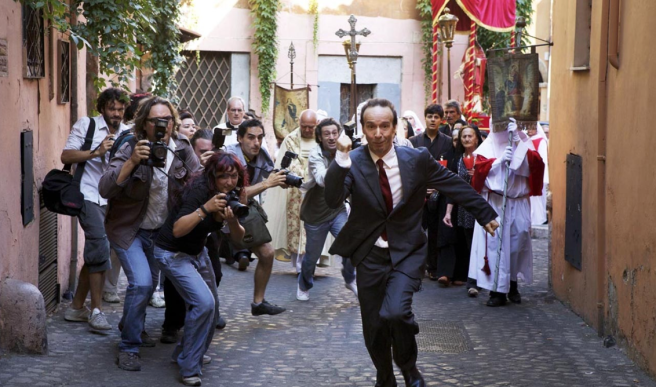
In the third story we meet Leopoldo (Roberto Benigni), a very average man. He’s middle aged, has a wife and a couple kids, works in an office, etc. One day he is suddenly hounded by the paparazzi and then ushered to the tv station where he is interviewed on air. He can’t go anywhere without being mobbed by fans and the media. He and his wife attend red carpet movie premieres, young women throw themselves at him and he can get a reservation at any restaurant. But then the attention becomes too much, and he wants nothing more than to be free of it.
When he asks his driver why he’s famous, his driver says he’s famous for being famous. Soon enough the paparazzi grow tired of him and turn their attention to another unsuspecting man on the street. At first relieved, Leopoldo begins to miss the attention. He runs around the street begging to being recognized.
Leopoldo runs into his driver again, and his driver reminds him that life can be a pain whether you’re a celebrity or anonymous, but it is better to be a celebrity.
Finally we have a story about a young architect named Jack (Jesse Eisenberg) who runs into a famous architect, John (Alex Baldwin). It turns out John used to live in the same apartment that Jack lives in, so Jack invites him up. Pretty quickly, John ceases being a real person and becomes Jack’s conscience as Jack tries to avoid falling in love with his girlfriend’s (Greta Gerwig) visiting best friend, Monica (Ellen Page).
This story is very predictable, and it’s been told in numerous Allen films. Guy is in a happy relationship, meets new girl (potentially a friend of the girlfriend) and falls deeply in love.
Even his girlfriend tells him that guys always seem to fall for Monica. Jack tries to resist, but John keeps returning to comment on the situation and remind him that he’s getting himself in trouble. Ultimately Jack and Monica get together, but she’s an actress and gets an offer for a film that’s shooting in Los Angeles and Tokyo for five months. Jack’s budding relationship with Monica is destroyed right before he was planning on breaking up with his girlfriend.
When Jack and John part ways, it seems clear that John was remembering this relationship from his past.
–
This film was funny and absurd, like many of Allen’s earlier works. Those works, like Sleeper and Love and Death created their own rules in regards to normative behavior.
Allen hadn’t made a film in a while in which a guy can inexplicably organize an opera on short notice for a guy singing in a shower box.
The four stories are driven by Hayley’s dad (Jerry), a dropped phone, a celebrity-obsessed society and one man’s lust for a woman he barely knows. Each of these stories feel familiar, but the story is driven by different forces each time.
It’s like a series of Woody Allen greatest hits, but they’re new sketches. There isn’t much overlap amongst the short stories other than they all end positively or with a lesson. It’s like each character gets away with something or learns something. Rome, the one constant, feels like a bubble in which people can practice for the real world.
Each story deals with one or more people visiting the city, so like almost all of Allen’s films set in a European city (minus Cassandra’s Dream), the protagonists are new to the city. Well, Leopoldo is the only one who lives there, but he’s an outsider to the city as he seems to know it. He doesn’t understand why he suddenly becomes famous, so even though he’s in his hometown, he’s still a visitor, dropping in on this community that astounds, delights, and even disappoints him.
Each story is about love, right? The story with Jerry, Hayley, Michelangelo and co. is about familial love. They bicker over Jerry’s persistence in urging Giancarlo to go out of his comfort zone. Michelangelo wants to protect his father, so Jerry’s actions cause a rift between the young Italian and Hayley. Ultimately they come together in harmony after a good showing for Giancarlo, and he rejects further celebrity in favor of his life with his family as it is.
In Antonio and Milly’s story, it’s about a romance or just young love. The story tests them and pushes them apart, but their marriage is (apparently) strong enough to bring them back in the end. It was clear that Antonio longed to find Milly, but her story appeared to be pushing her away from him, realizing he’s not the man she wants to end up with. And yet, she remains in love with him. Love wins.
In Leopoldo’s story, it’s about loving… yourself? He’s presented as a very ordinary man, but society begins to treat everything he does as if it’s special. He begins to think he’s special, but only once he’s lost his fame. Maybe it’s just a story about how fame does not equal love. Fame is fleeting, love is not quite as fleeting.
I hesitate to say that Leopoldo’s story is about loving yourself because I think that’s what John/Jack’s story is about. It’s ultimately about John taking a trip down memory lane, remembering what it was like to be young and living in Rome and reliving an old fling. He gives his younger self constant advice, trying to help him out of trouble. The tricks that Jack falls for do not appeal to John, showing how much he’s grown (it has been 30 years after all). When he and Jack part ways, they have some common understanding about love and the ways it fools you and simply doesn’t always work out. So he’s not as hard on himself as he used to be.
I have no idea what it all adds up to, but it was fun to watch. The film is lit warmly, very much like Midnight in Paris. Like that movie, this one feels like it was given ample attention and allowed to grow into something nice to look at. Some of Allen’s other films, to me Scoop and You Will Meet a Tall Dark Stranger feel rushed and neglected. Sure they grew into a feature film, but their bones are hollow, their shoulders are slumped and their ankles are swollen because they never got enough vitamins. Midnight in Paris and To Rome With Love were fed a healthy diet of grains and vegetables, given enough time to play outside and were properly tutored.
That all might be because of the cinematography. It feels cinematic in a way some of his other films didn’t, but many of his other films didn’t have to because the scripts were usually rock-solid (at least full of life), and the performances were awesome. The same goes here, but in some of Allen’s lesser films, everything just feels scattered. Nothing feels scattered here.
I kind of want to watch all of Woody Allen’s films in black and white to see how they feel. I hope he makes another one in black and white. This is a bit of a non sequitur, but I feel like that might change my perception ever so slightly on some of his mid-2000s films, so it’s not just for this one.
It’s nice to see Judy Davis in another Woody Allen film. I don’t remember when we saw her last, but I think it might have been 1998’s Celebrity. Alison Pill returns as well, having played Zelda Fitzgerald in Midnight in Paris. Oh, yeah and Jesse Eisenberg, kind of like Larry David but also not like him at all, feels like a natural Woody Allen surrogate. He talks quickly, he’s thin and doesn’t seem so tall, but he also seems incredibly intelligent. He feels like a young Woody Allen in some ways.
Jesus, I just looked it up, and this film got a 44% on Rotten Tomatoes. I thought it was way better than that. I think there might be some extra criticism of Allen’s later films because of what people expect going in. But Allen has written all kinds of films. Not all of his films will be a Manhattan, but most of them never were in the first place. He had gotten away from absurdist comedies like Bananas, Sleeper, Love and Death, even Annie Hall and focused more on grounded, relationship comedy/dramas like Hannah and Her Sisters, Husbands and Wives, even Manhattan Murder Mystery and The Mighty Aphrodite (though Aphrodite did veer into the absurd). This movie just felt like Allen having fun and writing funny short films, then stuffing them together. He gives actors a chance to play around, like Roberto Benigni gleefully/painfully running in the street, yanking down his pants and proclaiming that he likes with toast with butter and jam.
 idrawonmywall.com